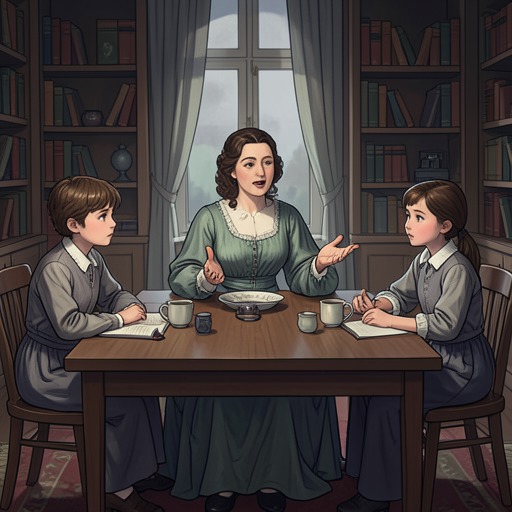
Katharine Hilbery and Mrs. Hilbery
Night and DayKatharine Hilbery and Mrs. Hilbery are bound by genuine affection and mutual reliance, yet they often inhabit different emotional worlds: Mrs. Hilbery turns toward memory, language, and family history, while Katharine quietly manages practical life and struggles to make her own present concerns understood. Their closeness is therefore both a source of support and a recurring difficulty, culminating in Mrs. Hilbery’s tearful acceptance of Katharine’s decision to marry.
A Bond Built on Care and Unseen Labor
Katharine’s place in the family is defined early by work that attracts little recognition. Disinclined to literary expression, she is instead entrusted from childhood with household affairs: ordering meals, directing servants, paying bills, and keeping the home in order. She also counsels and sustains her mother, whose imagination and insight do not make her well adapted to practical demands. In the family’s home in Cheyne Walk, Katharine’s management gives life an orderly, controlled appearance, while her mother’s more striking personality seems to dominate the household. The apparent harmony thus rests partly on Katharine’s largely unacknowledged labor.
That practical role is not the whole of Katharine’s inner life. While she is ostensibly helping with her grandfather’s biography, she dislikes the work of shaping feelings into phrases and is drawn instead to mathematics, which she pursues secretly. Her silence can be mistaken for indifference or mere usefulness; in fact, it accompanies a private intellectual life and a reserve that even she finds difficult to explain. Her mother depends on her, but their relationship does not automatically give Mrs. Hilbery access to what her daughter is thinking.
Shared History, Different Uses of the Past
The rooms in which Mrs. Hilbery works are filled with objects associated with Katharine’s grandfather. His books, pictures, furniture, and china call up vanished family figures, and Katharine imagines herself moving among them, knowing their secrets and foreseeing their mistakes. She feels attached to these people even as she sees how irrational their conduct and conventions could be. The past is therefore not merely her mother’s subject: it has shaped Katharine’s imagination too, though she approaches it with a more critical awareness of its confusions.
Their different orientations become visible when Mrs. Hilbery is writing and Katharine is trying to work beside her. Mrs. Hilbery can become absorbed in a new family recollection, while Katharine handles old letters and attempts to decipher them. At one such moment, her mother reflects that she is older than her father was when he died and delights in imagining herself as his elder sister. Katharine observes her mother’s happiness and pictures her rebuilding the past with each stroke of the pen. The scene conveys both the intimacy of their shared occupation and its imbalance: Mrs. Hilbery’s memories can fill the room so completely that the present, including Katharine’s own concerns, seems to recede.
Frustration and Instinctive Reconciliation
Katharine’s patience with her mother has limits. When Mrs. Hilbery turns again to old photographs and begins recalling the people in them, Katharine suddenly feels that her mother’s unspoken claim on her time and sympathy is unfair. She thinks that what her mother takes from her is wasted. Yet the anger breaks almost as soon as Katharine remembers that she still has to tell her mother about Cyril’s conduct. Concern for the pain the news may cause Mrs. Hilbery draws her back toward her, and Katharine crosses the room and sits on the arm of her chair. Her mother leans her head against her daughter. In this small exchange, tenderness does not resolve the grievance; it interrupts it and makes their dependence visible.
When the family discusses Cyril, Katharine first tries to protect her mother from a difficult disclosure, but the matter cannot remain unspoken. She tells Mrs. Hilbery directly that Cyril has a partner and children, correcting the impression that he is single. Once the facts are clear, Mrs. Hilbery reacts with genuine indignation, particularly at the concealment. Katharine feels relief and pride, and imagines that the two of them will take the situation in hand together. The episode briefly makes them allies: Katharine is relieved to find her mother’s judgment fixed on the facts, and their shared response seems capable of action.
That sense of partnership falters when the older relatives continue discussing what should be done. Katharine grows weary of their moralizing and of the stories they make to suit their own ideas of propriety. She stands by the window, frustrated both with her mother and with herself, unable to give her anger a clear direction. In that moment, the thought that perhaps she should marry William appears to her as solid ground amid the confusion. The impulse shows how a family discussion of other people’s conduct can press upon Katharine’s own sense of destiny, even when her mother does not recognize what it has stirred.
Marriage, Silence, and Recognition
Mrs. Hilbery’s advice about marriage shifts between idealization and qualification. She speaks of a happy marriage as a woman’s happiest life, then corrects herself: it is, she says, the most interesting life. Katharine feels a brief recognition between them, as though they understand one another despite their differences. But she also senses that their experiences do not settle her individual question. She thinks that the older women around her have been content with little happiness, and cannot be sure that their account of marriage fits her own state of mind. Her mother admires and relies on Katharine’s reserve, but that same reserve makes it difficult for Mrs. Hilbery to know what her daughter needs.
This gap appears again when Mrs. Hilbery imagines a married future for Katharine in a country house, complete with separate studies and a sitting room for her daughter. Katharine shivers and tries to bring the conversation back to marriage so she can hear her aunt’s views. Mrs. Hilbery’s picture is affectionate, but it turns Katharine’s future into an inviting domestic scene before the daughter has made her own feelings clear. The contrast is not simply between a loving mother and an ungrateful daughter: Mrs. Hilbery’s hopes are sincere, while Katharine’s hesitation reflects a private uncertainty that maternal warmth cannot answer for her.
When Katharine finally makes up her mind to marry, the news reaches Mrs. Hilbery through a silence that first unsettles her. In a letter to her sister-in-law, Mrs. Hilbery recalls sitting alone, deciding not to call her daughter in with her troubles, and then feeling happy when Katharine came and sat beside her. Katharine eventually tells her that she has decided and has written to the man she expects the next day. Mrs. Hilbery is not immediately glad; she had not wanted Katharine to marry anyone. But Katharine assures her that she will always care most for her parents, and her mother recognizes that her own first response has been selfish. She tells Katharine to give her future husband everything and says she will be thankful to come second.
The letter does not turn that acceptance into uncomplicated happiness. Mrs. Hilbery describes herself crying and feeling old, even as she imagines that Katharine’s marriage will bring the family a son, keep the couple nearby, and allow the work on the biography to continue. She hopes that the outcome will prove more wonderful than she can imagine. Her response holds grief and generosity together: she must relinquish the exclusive closeness she had wished to preserve, but she also blesses Katharine’s new attachment and tries to find a future in which family affection continues.
The Past, the Biography, and Emotional Misunderstanding
The biography of Richard Alardyce gives the relationship a shared task, but not a shared attitude toward work. Mrs. Hilbery can be carried away by literary and historical enthusiasms, while Katharine is more conscious of the labor of sorting documents and maintaining a schedule. In spring, Mrs. Hilbery’s renewed delight in words leads her to develop a playful theory about Anne Hathaway writing Shakespeare’s sonnets. The joke draws her into Elizabethan reading and thoughts of Stratford-on-Avon. At the same time, Katharine is sitting with an old letter, deciding whether to print it in full or only preserve its reference to Shelley. Their desks place them side by side, but their attention moves in different directions: her mother follows an imaginative theory, while Katharine weighs documentary detail.
Mrs. Hilbery also tries to interpret Katharine’s romantic life through the language of literature. She imagines giving copies of Shakespeare to working men and staging a play in which family and friends take roles; then she tells her daughter that what people say when they are in love is not nonsense but truth. Katharine nearly interrupts and nearly confides in her, but her mother turns to Shakespeare to find a passage that will express the feeling better. Katharine instead blackens one of the circles she has been drawing. The moment brings them close to an understanding, then lets language and hesitation stand between them once more.
Even so, Katharine does not simply reject her mother’s company. When Mrs. Hilbery promises to leave her alone so she can receive Mary Datchet, Katharine says there is no need. Her firm return to her work hints at a stern, self-contained part of her character, but it also resists the assumption that the daughter must be separated from her mother in order to have a life of her own. Their connection persists through disagreement, unspoken thought, and care. Its defining tension is that Mrs. Hilbery often loves through memory and imaginative speech, while Katharine’s love more often appears as practical attention, guarded feeling, and the effort to protect her mother from pain.